Tuesday, February 18, 2014

Leni


© 2013 by John LaTorre

Her name was Leni Keiner, and she came into our lives in the late 1950s. Her occupation was "Putzfrau" or cleaning woman, but she ended up being much more than that.

She was not the first maid my family had. When my parents lived in Hillcrest Heights, Maryland, both of them worked for the Central Intelligence Agency, which meant that they had both the income and the need to hire somebody to do some cleaning and ironing, and to make sure their two young sons had somebody to take care of them when they came home from school. They ended up engaging somebody I knew only as Mrs. Bouvier. Mrs. Bouvier didn't think much of of us kids, nor we her, but we generally respected each other's space. My only complaint was that we couldn't watch our new television when we came home from school, as Mrs. Bouvier insisted on watching it as she did the ironing. She favored soap operas and game shows such as "Queen for a Day," whose format consisted of several women telling the world their problems, after which the audience would determine which of the contestants had the most miserable life; the winner would be named Queen, robed and crowned as befitted her new estate, and showered with appliances, perfume, and other prizes. (I don't remember whether any of the other contestants got anything for their troubles.)

We moved away from Hillcrest Heights when I finished second grade. After a year in Bethesda, my father got a promotion and a reassignment to West Germany. This was in 1957. We lived "on the economy," in a rented apartment, for a few months, and then were assigned quarters in one of the US housing areas that had been built in the early fifties to accommodate the huge number of military families in Frankfurt.

One of the first things my mother learned was that maids could be had dirt cheap. Germany's economy, ravaged during the second World War, had been slow to recover, and there were more able-bodied people than there were jobs for them. So many people who would otherwise have been shopkeepers and skilled workers took whatever jobs that could put food on the table. Mom also discovered that our apartment building had a series of rooms on the attic floor, which I think were intended for single officers but were mainly used instead for maid's quarters. Evidently, these could be had for a small fee, and the attraction of a room in an economy short of living quarters was a powerful inducement for young women to take up temporary careers as maids.

As I recall, the first maid we hired was Julianna. A middle-aged woman with bad teeth and an easy laugh, she quickly made friends with me. I saw her knitting one day, and she taught me to knit, a hobby I practiced until Mom told me that it was not a manly thing to do. Julianna would also play records on our new hi-fi, which my parents didn't mind. She also helped herself to the family liquor cabinet, which my parents minded very much, so she was given her pink slip.

The next one was a quiet, docile girl named Renata. She did everything quietly and without complaint. I didn't get to know her as well as I did with Julianna, but that was probably because she didn't last as long. My parents got a call from the German police one day. Evidently one of the maids had been stealing from the other maids on the floor, and after some investigation they determined that it was Renata. So she was taken away to the pokey, and we were maidless again.

There may have been another maid or two, but then Leni came along. She had some advantages: she was as honest as the day was long, she had unfailing energy, and she could speak some English after a fashion. Mom was delighted to find her, and before long she was a regular employee. Also, she had her own apartment in a nearby suburb, where she and her husband lived on a pension and from which she commuted by means of a big, heavy, black bicycle, thereby saving Mom and the Dad the maid's-room fee.

Leni's frame was largely composed of spheres ... a round head, a stout body, heavy breasts, and fat hands. She had a pale complexion and straight black hair, mixed with gray and usually pulled up in a bun ... yet another sphere ... on her head. She was stronger than she looked, and when engaged on a project like scrubbing the floors, she preferred to work at a constant vigorous speed rather than stop for rests. She would usually arrive at ten in the morning, after we kids had gone to school, and we would first see her when we came home for lunch (our school was only a few hundred yards from our apartment, so we seldom took our lunches there). She would have chicken noodle soup ready for us, and would make us peanut butter sandwiches (which, in her fractured English, would come out "peanoots-booter sandvich"). She would usually be gone by the time we got home in the afternoon, having gone to her own place to prepare dinner for Herr Keiner. Once in a while, though, she would stay longer, if my mother needed her to; this was usually when we were having company, and Mom wished to serve dishes that were beyond her modest cooking skills. When Leni was finished, she would announce her departure in German, or more accurately, in the particular dialect of Hesse: "Ick geh' da-hahm."

In 1960, our family adopted a baby girl, and my mother was suddenly busier than ever, so Leni stayed longer and longer. She was the first grandmother-figure my sister had. In fact, in large part, she was the first grandmother-figure my brother and I had, too; Mom's mother died before I was born, and Dad's mother never really established much of a relationship with is, preferring to talk to us in Italian, a language we never learned. When I think of what a proper grandmother should be like, it's always Leni who comes to mind.

I can't say that she ever impinged on our social life, or we on hers. I do remember going over to her house from time to time, where she would serve us tea and cookies. (When visiting in Germany, it is expected that one will be given at least tea and cookies. Anything less is considered a horrible breach of etiquette.) I almost never saw Herr Keiner. He was often there, but preferred to stay in another room, smoking and watching television or listening to the radio. But Leni was usually there at our birthday parties, whether as a friend or a servant I neither knew nor cared. And, once or twice, I met her daughter, a middle-aged woman with a trim figure and a reserved politeness to me.

Our family returned to the States in 1962, but were back in Germany for another tour in 1964. And again we hired Leni whenever we needed a maid. Her hair was grayer, but she never seemed to slow down. In 1965, I was hit by a car and spent several months in the hospital. One day, my father brought me something. It was a medal, awarded to soldiers in the German army who had served in the Franco-Prussian War. My father told me that it was from Herr Keiner. To this day, I have no idea where Herr Keiner obtained it; he was too young to have participated in that war, but it might have been earned by someone in his family, or he may have purchased it from a veteran. (Such medals can be bought today for about twenty to thirty dollars, which suggests that there were probably a great many of them in circulation at one time.) And I'm not sure whether he meant to indicate that I, too, was fighting a battle that deserved recognition, or that he simply thought that the medal might be something a teenaged boy might find cool to own. Either way, I was touched. I have it to this day.


My parents moved back the United States briefly in 1969, and then for good in 1974. I don't remember seeing Leni when I visited them during my college days, but my sister tells me that Leni was constantly in her life during that time. Once our family had moved stateside for good, we lost touch with her. I guess that she was, in the end, just another employee with which our family had a long relationship, and I have no reason to think that were more than steady employers to her. But now that I'm at the age that she was when we last met, I think that I'd like to have known her better. I think that we could have been friends of a sort, or even part of an extended family. I guess I'll never know.

Wednesday, February 5, 2014

High Praise From My Father


My father never gave me much in the way of direct praise for anything I did. He didn’t criticize much, either, but I got the feeling that if I did anything well, I was simply doing what he expected me to do, and extravagant praise wasn’t necessary. When I did something right, his response was usually a sardonic “Good work, man! You’ll make PFC for this!” I also remember him saying, “Son, sometimes you display almost human intelligence!” That was his style of humor, and he would not spare himself as its target. After he'd finish a project, I might hear him say, “Well, I think I've done enough damage for one day.”

He was never the demonstrative type. Maybe that had something to with the fact that he was essentially a very private person, never letting anybody know how he felt about anything. This trait was, of course, a job requirement for his career, which was as an intelligence analyst for the Central Intelligence Agency. His job was to absorb and interpret information, not to offer it. For example, he would interview people who had just escaped from eastern Europe and glean whatever information he could. If the refugee had been a butcher and had been supplying meat to a nearby military base, my father might ask him questions like “Did you sell more meat at some times of the year than others?” or “Did the types of meat that were requested vary from one year to the next?” The answers to these questions might indicate possible military build-ups, or soldiers being drawn from different ethnic groups as time passed. It is of such seemingly insignificant bits of information that the fabric of intelligence is woven.

I learned all this only after he retired. I knew that he worked for the CIA since I was in high school, of course, and that we weren't supposed to tell anybody what he did. That was fine with us. I remember Dad asking me at one point in my early college days if I had given any thought to applying to the Agency for a job. If I wanted one, he could have probably pulled some strings for me, since the Agency preferred to recruit from within the families of their employees wherever possible. But I didn't have any interest in that sort of thing, and he let the matter drop.

I remember one time, though, that he complimented me for something. The occasion was my brother’s wedding in the summer of 1984. My father and I were in Santa Rosa, California, looking for a music store that stocked some sheet music that my future sister-in-law wanted for the ceremony.

Carole had given us the address of the music store -- 741 Fourth Street -- but not its name. But that didn’t do us much good, since at that time, none of the businesses displayed their street numbers on their storefronts. Even when we found the street, we didn’t know where the store was, or even in which direction it was. We must have spent a good half hour driving up and down Fourth Street, looking for the place.

While we were stuck in traffic, I noticed a Santa Rosa telephone book on the back seat of our borrowed car. It wasn’t the Yellow Pages, which may have been more useful, but the White Pages. I picked it and studied it for a minute. As the light changed, I said to my father, “The music store is in the next block, about halfway up the street, on the left side.”

“How did you know that?” my father asked.

“Well, I saw that the business we’re in front of is named Mac’s Deli. I looked it up in the phone book and it listed the address as 630 Fourth Street. The business next to it is the Farmers’ Empire Drug Company. The book says that its address is 640, which means that the numbers get bigger as we travel down the street. So the music store must be in the next block. And 630 and 640 are on our right, and they’re even numbers. So since the music store’s street number is odd, it must be on the left.”

My father gave me a long look, the kind of look that a parent gives a child who has just demonstrated some completely unexpected talent, and said, “You know, you would have done well in the Agency.”

High praise!

Tuesday, January 28, 2014

RIP Pete Seeger


I got word today that Pete Seeger is no longer with us. He was 94.

The sad thing isn't that he died. He had a life that was far longer and richer than most of us have any right to expect, and he was active right up to the end. The sad thing is that he will never get the Nobel Peace Prize that he richly deserved, for showing us how music can bind the peoples of the world together, and demonstrating how humanity's common traits overshadow our differences.

After his blacklisting in the fifties and sixties cut him off from earning a living in the United States, he traveled around the world, sharing the richness of American song and harvesting the richness of the songs of other cultures and bringing them to us. In particular, he brought home a song written by a Russian child, and a marching tune of the Red Chinese army, and included them in his concerts. For him, there were no important national boundaries. He was not the first musician to cast himself as a good-will ambassador, but he was arguably one of the most effective ones, and the one most willing to cross hard political boundaries. Who else could bring to a concert audience the feeling that people all over the world were just like them in most respects, loving their children and worrying about tomorrow and ready to repay goodwill with goodwill?

Another thing about his concerts come to me. He wanted people of all ages to come to them, from toddlers to grandparents, and he made sure that there were children's songs to round out his repertoire. That was a part of his vision of music as a unifying force. “Young and old” was just another meaningless distinction to be erased, like “black and white” or “American or Russian” or “male and female.”

He changed American popular music in more ways than people realized. He was responsible for the resurgence of the twelve-string guitar after World War II, he pretty much invented the long-necked banjo, he changed one word of the Baptist hymn "We Will Overcome" to "We Shall Overcome" and converted it from a hymn to an anthem, he wrote or co-wrote "Where Have All the Flowers Gone," "If I Had A Hammer," and "Turn, Turn, Turn" ... and the list goes on.

I wonder if his kind will ever come again. His champions, who include Arlo Guthrie and Bruce Springsteen, are themselves getting older and less relevant to the musical community. Are there young people now willing to take up the torch, and use music and love as a way of bringing people together, fighting social ills, and celebrating our common humanity? I won't say that we need them more than ever, because we have always needed them and we will always need them. But when we see these young talents coming forth again, it will be like seeing the first flowers after a long winter. And it wouldn't be soon enough for me.

Pete was intensely political, but he wasn't dogmatic, and wished for dialogue between people who disagreed with each other. Asked if he read the Communist Daily Worker, he said, "Yes, I do. And I also read the Wall Street Journal. And what I'd really like to do is get the writers of both newspapers together in the same room." At the end of his life, he had plenty of adversaries, but no enemies. 'Tis a consummation devoutly to be wished, that.

Tuesday, January 14, 2014

A Picture of My Father


©2013 by John LaTorre

A few years ago, I built a wooden trailer that had a canvas top supported by a latticework of wooden and aluminum poles. The canvas has been replaced twice since then, killed by the fierce sun of several Sacramento valley summers. When I removed what was left of the most recent cover, I noticed some dry rot in some of the wooden members, and replaced those components with new wood and plywood. And then I waited for fair weather to paint the new members. That day came in mid-December, with a clear blue sky and light winds. I put on an old sweater and some ragged jeans, and set to work putting a coat of primer on the bare wood of the cover’s skeleton. 
 
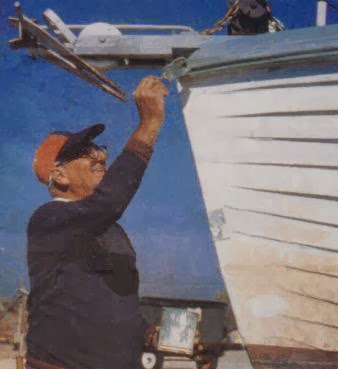
As I painted, a picture came to mind of my father performing a similar job on his boat. He’d retired to Florida after a career as an intelligence analyst with the Central Intelligence Agency and bought a twenty-five-foot wooden boat in need of a bit of restoration. He had it pulled out of the water, and paid some young men with strong backs to scrape the barnacles off and prep it for painting. He saw no reason to pay somebody else to apply the paint, though. He could do that himself.


A local photographer named Jim Stem had gone out to the marina to take some pictures of local residents doing the sort of things that local residents do there, and he took a fine picture of my dad, in the sweater and golf cap he used to wear during the winter, applying paint to the hull of his boat. The camera caught him in profile, from about his waist to his head, framed against a robin’s-egg sky – the very picture of a man enjoying his golden years on Florida’s Sun Coast, exemplifying the retirees who comprised much of the paper’s readership. Jim Stem knew his audience. The picture ran in the Pasco Times that month.

I saw the picture when I visited him one Christmas. It was hard to miss, actually, because either he or my mother had had it framed and displayed in the family room. It continued to hang there for at least ten years, until my father decided to move back to his hometown of Syracuse, New York. I asked him why he was moving back there, and he told me that now that he was over eighty, he no longer felt the need to shovel snow; he could let younger men with stronger backs do that, too.
 
I found it odd that Dad displayed it so proudly, since he was quite camera-shy. This reticence was the result of twenty-some years of working for the CIA in the field or, in other words, twenty-some years of being a person whose job it was not to be noticed. Some documentation of his life was unavoidable, of course, since his name would be published in things like marriage announcements and the like. But the policy of the Agency was, quite reasonably, that the less of this information that was around, the better.

I remember a time he came home from one “TDY” – Army-speak for “Temporary Duty.” He would go on such things from time to time, staying a few days or even a few weeks. I didn't ask him where he’d been. I tried for a while, but he would only smile and shake his head. He knew that I was far too young and garrulous and guileless to keep a secret. (I am still garrulous and guileless, but now my beard is gray.) The only hints of his destination would be the things he brought back as presents: two small stuffed alligators from some place that had alligators, some “Mexican jumping beans” which didn't jump, a couple of transistor radios at a time when these things were just starting to hit the market. On this particular occasion, the only thing he brought home was a Polaroid snapshot of him sitting on a seat of an airliner, looking startled. He told us that free-lance photographers would take these pictures and offer to sell them to the subjects as souvenirs of their travel. Dad bought it, of course, since it was more than a simple souvenir to him. It was documentary evidence that he’d been someplace where he perhaps shouldn’t have been. It may not even have been the only photograph that the photographer shot of him, and there wasn’t anything he could do about that. But it was necessary to do what he could, and if that involved buying a picture that he didn’t want in order to take it out of circulation, then so be it.

Such discretion paid off in the long run. In 1968, the East Germans published a book called Who’s Who in the CIA, which blew the covers of hundreds of government agents. The idea was to embarrass the Agency by demonstrating how much the East Germans knew about our operations in Europe. At the dinner table that night, Dad did something he never did before or since, in his entire career with the CIA: he broke his habit of never discussing his job. He said, with visible relief, “They got a lot of us, but they didn’t get me.” I was twenty by then, and I guess he felt he could trust me to keep my mouth shut. I’d known by then that he worked for the CIA, but still didn’t know exactly what he did for them. It would be another fifteen years before he told me.

Dad lived in Florida for over twenty years, but made no deep friendships there. So when my mother passed away in 1993, he decided to move back to Syracuse, his hometown. He wanted to be around what remained of his own family, which at that point consisted of a brother, a sister, and a few in-laws, all of them living in in the Syracuse area. As these people died in their turn (only one of my father's six siblings survived him), their places in his life would be filled in some measure by those of their children and grandchildren who had decided to stay there. My brother and I tried to persuade him to come to California, but he would have none of that. He bought another boat, a smaller aluminum vessel, to sail on Otisco Lake, the scene of many of his most treasured boyhood memories. He would take it out regularly until a stroke robbed him of most of his sense of balance.

But back to the picture. Once my father started working for the CIA, I don’t remember him having his picture taken at all, except by family members on holidays and reunions. This is why the picture in the Pasco Times was so remarkable: ten years before, my father would have been very unhappy about having his picture taken, and would probably have asked the photographer not to publish it. But now things were different. Displaying that picture proudly in the family room was his declaration of independence. He didn’t have to hide now. It was all right to let the world know where Joe LaTorre could be found, and what he was up to these days. Nobody cared anymore.

At the time when the picture was taken as he painted his boat, he must have been at about the age I am now, in my oldest sweater, painting my trailer under a clear blue Sacramento winter sky. We become our fathers and our mothers, by and by, even when we aren’t watching.


Tuesday, January 7, 2014

I Cut Myself Today


I cut myself today.

I was chopping up some carrots, and the French kitchen knife slipped and grazed the side my right thumb. (I'm left-handed, which is why it was not the left thumb that was damaged.) The knife didn't cut very far, though. It took almost a minute to start bleeding, and the wound was dressed without a lot of fuss, once I got the bandage unwrapped with only one hand.

I should add at this point that I have a reputation for hurting myself in several small ways (and a few large ones). I have cut myself so often that the instructions on a Johnson & Johnson Band-aid -- "Tear off end, pull string down"--are now imprinted on my memory like a mantra. My hands bear numerous scars whose provenance I can no longer recall. So this sort of experience was nothing new to me. Indeed, the most remarkable thing is that this one showed every sign of healing up with no permanent damage at all.

So if I had been anybody else, this little incident would have been shrugged off. But I'm different. I was raised on the stories I read in the Reader's Digest and the Ladies Home Journal and the Redbook magazines that my mother subscribed to.

(Full disclosure here: I talked my mother into subscribing to them. The subscriptions were part of my high school's fundraising drives for the stadium lights that would illuminate our team's night-time games, many of which we actually won. The school administration also probably hoped that the increased illumination would cut down on the hanky-panky that pubescent students performed under the bleachers. They were mistaken; if anything, it made the darkness down there even darker and more inviting by comparison. When not studying, performing on the field, cheering from the bleachers, and fornicating under the stands, we students were expected to go door to door, selling subscriptions to neighbors, but appealing to Mom's maternal instincts was usually good for at least six magazines even before I left the house. The trick was to get to her before my brother -- who went to the same high school -- did.)

These stories in these magazines usually started with something like "As the knife/nail/glass went into my thumb/forefinger/toe, I had no inkling that my life would change forever." They would go on to detail the diseases the narrator had caught and the nerve damage inflicted, with the inevitable descent into sepsis, amputation, near death, and possibly an iron lung or something of the sort. This is not the sort of narrative that you feed to an impressionable high school freshman who had already been exposed to an Irish Catholic mother. Irish Catholics are convinced that disaster is already around the corner, waiting to pounce. If it's sunny today, it will be sure to rain tomorrow. (In Ireland, it always rains tomorrow.) If things seem to be going smoothly, it's only because the Fates have somehow overlooked you, having been momentarily distracted by their glee in visiting misfortune on somebody else. Sooner or later, they're sure to remember their appointment with you.

I dosed the cut with an antibiotic cream, but I'm not counting on that very much. That's what everybody in those stories did. It never helped. Sure, everything feels fine for a day or two, but disaster is sure to strike. That usually happens by the seventh paragraph, after they've described in detail their happy family in a wonderful neighborhood where all the dads are employed in meaningful jobs and all the moms are home cooking up all the recipes that are found elsewhere in the magazine (most of them apparently having something to do with the artful application of Campbell's Cream of Mushroom Soup). This happy interlude sets up the part where, when the wound doesn't seem to be healing on schedule, the family decides to take the victim to the doctor. The doctor expresses concern. He (and in 1962, it's always a he) says comfortingly, "I'm sure that it's nothing serious, but I'm going to order a few tests anyway. Now just keep that wound clean and dry and everything will be fine."

Little does he know. A week later, the victim is back in the doctor's office, where he unwraps the wound. he examines it. He scowls. More tests are given. There are injections. The patient is comforted by the fact that the doctor looks like Doctor Kildare or Ben Casey or Marcus Welby, and that no doctor who looks like that can possibly find himself out of his depth. Modern viewers are not so easily reassured. They were raised on House, and know that even the most brilliant diagnostician will make three or four wrong diagnoses as the patient hovers between life and death. But these were simpler times.

Anyway, The story inevitably concludes with a hospitalization, usually accompanied by the aforesaid amputation or a collapse of the immune system or both. Weeks pass as a grueling re-adjustment is made to the patient's life-style. Because the magazine is a family publication, the patient can be counted on to make some sort of recovery, or at least an adaptation to new circumstances and a renewed appreciation of the Value of Life. He or she credits doctors, nurses, family members and friends for their unfailing support and skill. The reader then turns the page with newfound respect for the medical profession, and finds an advertisement about the many ways that Heinz ketchup can enliven your next meat loaf.

I'd better go change that bandage now. Not that that will help.

Thursday, December 26, 2013

The Flag Case


©2013 by John LaTorre


When my father, a veteran of World War II, was buried at Arlington National Cemetery in 2005, my family was presented with the flag used in the ceremony.  It was entrusted to the care of my nephew, Bill Rossiter, who has it in his home in Florida.   
My sister Anne called me about a year ago and gave me a suggestion: make a case for the flag as a birthday present to her and Bill (who is her son).  I pointed out that cases could be purchased for around forty dollars, and would probably be better than any I could make with my journeyman woodworking skills. But she eventually convinced me that the personal touch meant everything to her, and I agreed to the project.
I got the measurements I needed and went shopping for wood at our local hardwood emporium, and that’s where I hit my first snag. There were a lot of choices, ranging from walnut to exotic woods with names like cocobolo and zebrawood. Red oak seemed a good choice at first, but I felt that my sister would want something a little more traditional, like walnut or cherry. I found myself asking, “What kind of a man was my father? What would he have liked? Was he a walnut sort of fellow, or an oak guy, or a cherry guy?” The answer was obvious. He was a cheap wood guy. If he’d made that case, he would have used pine or poplar, or even plywood scraps left over from another project. But Anne would have hit the roof if I’d used those. That was my first epiphany: I wasn’t making the case for my father, but for my family. So plywood was out.
I rooted through the bins and came up with a piece of walnut with a good grain and no bends or twist to it, a sign that the wood was stable and would probably stay that way for a long time. Walnut is an honest wood, not very expensive and capable of a warm finish. Dad wouldn’t have minded that. So the board went home with me.
My second epiphany came when I began sawing and machining the pieces into shape. I have to explain at this point that when my father undertook projects like this, the results were always functional but sometimes not very pretty. Our house was full of little gadgets like this. They were ugly, but they worked, and that was all that counted with my father. My brother Joe coined the perfect term for these curious artifacts. We called them “daddifacts.”
It wasn’t until much later that I realized that the daddifacts were an outward expression of his philosophy of life, derived from the only sport that he pursued throughout most of his adult life. Dad was a golfer, and tried to teach me the game, but it really wasn’t my sort of game. But I did learn the golfer’s Prime Directive: Play It As It Lays. Any golf shot results in the ball resting in a specific location, seldom an optimum location. You can’t improve the lie of the ball, or move it a few feet to one side or another (except in special circumstances), without incurring a penalty, and the point is not to try to. Instead, you got out of your predicament by, say, hitting the ball back onto the fairway where you have a chance of salvaging your score with a clean shot to the pin.
The same principle applied to his craftsmanship. If a piece came out a little wrong – lopsided, or slightly cracked or splintered – but it didn’t interfere with the utility of the finished object, he let it slide. If it needed paint, he’d use some of the stuff he already had on his shelf, regardless of the color, rather than go out to the store to buy more. If it broke, but a bit of glue put it back in operation, he made no effort to hide the glue line. Every daddifact told the story: “This is what you’ve got. It will work. Accept it.”
Nowhere did my father illustrate that philosophy better than his recovery after a devastating stroke he suffered in 2003. Dad loved to walk, and it took away his sense of balance. He loved to talk, and it took his speech. He loved to eat, and it impaired his ability to swallow. And he loved to read, and it damaged the part of his brain that processed the written word.
Dad would certainly have been entitled to be bitter at this fate, but he never showed it. Instead, he applied himself to regaining enough of his strength and balance to graduate from a wheelchair to a walker. After months of speech therapy, he was able to make himself understood even to strangers. After a year, he trained himself to eat solid food and drink unthickened liquids without choking. And, most important to him, he learned to read again, training a different portion of his brain to substitute for the damaged areas. And he did all this at the age of eighty-eight. If a second, even more destructive stroke hadn’t hit him a month before his eighty-ninth birthday and rendered him brain-dead, I’m sure he would have continued to improve. I still dream about him, and in my dreams, he’s walking again, unsteadily but confidently, waving my arm away.
I realize now that he was applying his golf philosophy to his recovery. He resigned himself to what he had lost, discovered what he had left, and figured out how to use it to get back into the game. He was playing it as it lay, one shot at a time.
So when I built the flag case, I wasn’t too worried about how it turned out.  As it happened, it went together pretty well and doesn’t look bad. But if you look closely enough, you’ll spot an imperfection here and there. I could have worked to eliminate it, or simply started over with more wood, but somehow I felt that my father’s memory would be better honored if I just soldiered through, accepted the flaw, and kept plugging along … in other words, if I just played it as it lay.

Thursday, December 19, 2013

Nativity Set


Copyright 2009, 2013 by John LaTorre

At a garage sale the other day, I noticed a Nativity set (also called a “creche set”) on a table. For those who are unacquainted with the term, let me explain that a creche set is a collection of statues which represent the participants at the first Christmas. There are always figures of Joseph, Mary, and the infant Jesus; the more complete assortments also include one or more angels, a shepherd or two, the three Wise Men, and various livestock like sheep, cows, and camels. These figures are used as Christmas decorations in Catholic households and, like the other decorations, are usually set up on the first Sunday in Advent and taken down after the Feast of the Epiphany, wrapped in paper, and stored away with the other decorations until the next Christmas season.

I noticed that this set had no price tag and, even at the closing of the sale, no customers. When I asked the salespeople what would happen to it, they told me that everything that wasn't sold was going into a dumpster. Being the sentimentalist that I am, I took the set to donate to a Catholic church in the neighborhood, in the hope that the set would find its way to some family who would find it as fascinating as I did when I was small.

Our own family always displayed a creche scene at Christmastime, eventually acquiring a genuine Hummel collection when we were stationed in Germany for a while. Like most families, we would set the figures of Mary, Joseph, and the empty manger out at the beginning of the season, and add the figurine for the baby Jesus on Christmas Eve. In Catholic families, this is traditionally done by the youngest child in the family, which was me until I was eleven. Then my sister came along, and it was her turn. I remember adding my own variation: while the creche set was set up on one side of the living room, we would put the shepherds and their sheep on the other side, and these would not be added to the main collection until Christmas Day.

This variation was probably inspired by another tradition we had. The figures of the three Wise Men were put up in the most distant place in the house from the living room. On Christmas Day, they were moved a twelfth of the way to the creche. Every day thereafter, they traveled a little further through our house, until they arrived at the manger on January 6. (I seem to recall that my siblings and I took turns moving the company a little each day.) It was my mother's way of dramatizing the Christmas story, I think, and of allowing us children an opportunity to participate in it. As far as I know, our family is the only one who practiced this particular ritual, although Mom may have heard of it from somebody.

There isn't much room in my life for a creche set anymore, but I hope that the family who ends up with my garage sale acquisition ends up with the same warm memories I had of our set, and finds their own way to commemorate the Christmas season. It's a perfectly good set – all the major characters are there, all in suitably devout poses. With a little luck, it can serve a number of families for a long, long time.