Sunday, September 20, 2020

On Ruth Bader Ginsburg's Death


When Justice Ginsburg died, her final wish was that the process for choosing her successor would be delayed until after the next inauguration. In doing so, she hoped that it would be the deliberate decision of  a body that most truly represented the wishes of the American people, rather than a ploy by one party to grab as much power as they could from the opportunity.


Instead, Mitch McConnell, the Senate Majority Leader, has expressed his intent to push the decision through in record time, even before the election if possible, and certainly before the next inauguration. In doing so, he has expressly ignored the last request of a dying woman who, to the last, had the best interests of the American people at heart.  


He has repudiated the same logic that he himself used in thwarting Obama's nomination of  Merrick Garland to the Supreme Court. (To refresh your memory, McConnell refused to even submit the nomination to the Senate, on the grounds that it was so close to a Presidential election that it be better if the debate were held until after the next president's inauguration, to better reflect the wishes of the people.)


In expressing the intent to rush a Supreme Court nominee to Senate approval, it seems to me that the Republican Party has clearly forfeited any semblance of decency and propriety in the interests of keeping their party and its values intact as long as possible. It obviously cannot be counted on to do what is right, what is moral, what is decent. 


Is there anybody out there that can defend this as the right course of action for any reason other than to advance the aims of the Republican Party? Is there anyone who can honestly think that it's a respectful homage to a distinguished servant of the people?


I have had enough of this. I will say once again that this nation has a cancer. It is a cancer that will eat away at the nation's most vital organs: the right of citizens to a fair election process, their right to equal protection under the law, the rights accorded to all human beings under international agreements, and the proper use of government to safeguard the health of its citizens. That cancer is the Republican Party, which has fought these things tooth and nail for the past half-century.


The cancer must be stopped, or it will kill us. Instead, we must kill it. I call for the death of the Republican Party and all its mechanisms. We must root it out, every cell and every poison that it creates.


You will say that there are many Republican lawmakers and governors who are good people, and who have their constituents' best interests at heart. If that is so, let them resign the party and run as candidates of another party, or as Independents. 


You will say that there are many Republican citizens who are good people, and do not hold the values that the current GOP embraces. Very well, then, let them stop subsidizing and supporting that party. Let them vote for Independents, or as members of another party. Let them make it clear to the rest of us that the Republicans can only survive on what corporate America gives them, and corporate America seldom has as much concern for you and me as it has for its own balance sheets. 


But, in the meantime, here is something that Republican Senators can do: nothing. They can refuse to approve any nomination for the Supreme Court until after the inauguration. In fact, it may not be necessary for them to take any action at all. They can simply refuse to show up, and thus deny the Senate the quorum it needs to conduct business. (There are ways to get around that, to be sure, but they will need to be tested for their validity, and these will take time.)


But here's the thing: this will be a Litmus test. If a Republican Senator even shows up on the floor for such an appointment hearing, he or she will be advertising their support for McConnell's agenda. They will be openly declaring themselves to be on the side of the forces of repression and against the forces of liberty. Pure and simple. We may not have the evidence to convict them of treason, but we have both the right and the duty to call them out and ask them to defend their actions, and to tell them that their ride on the Congressional gravy train is at an end.


So now it's time to see if the Republican Party can re-grow some of the integrity it displayed in the past, or whether it's asking to be torn down, stone by stone, until there's nothing left. Because if it can't reform, by God, that destruction is what I'll be helping to bring about. I promise to vote for no Republican, ever. I promise to donate to the campaigns of those who would remove Republicans from power. I promise not to be silent when Republicans abuse that power for their own ends. And I encourage each of you to do the same.


Let's kill this cancer. It's war.


Monday, July 6, 2020

The Parable of the Loaves and Fishes


©2020 by John LaTorre


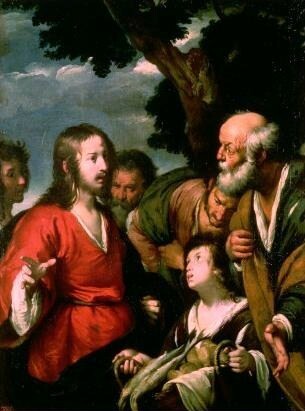
There are two stories in the New Testament that tell how Jesus feeds the multitudes by miraculous means. In the first instance, he feeds five thousand people with five loaves of bread and two fishes. In the second instance, he feeds four thousand with seven loaves and two fishes. In each case, there is a lot of food left over.

For those of you who have trouble accepting the veracity of the story, I suggest an alternative more in keeping with the spirit of Christianity that Jesus espoused, a spirit that so many Christians have trouble accepting. It goes like this:

As usual, Jesus and his disciples had attracted a crowd, and he was concerned about how they were going to be fed if they got hungry. Some of his followers suggested that they send the people back to town, but Jesus said that there was enough food already there, so there was no need to send them away.

He knew that most of them were intelligent people, and reasoned that they would have some food of their own on hand, since one shouldn't walk into the desert without bringing enough food to tide them over. They'd already heard that his sermons would often go on for a long time, and they came prepared.

But there are always a few who aren't so intelligent, and it was these people that Jesus was worried about. He asked his disciples how much food they had on hand.

"Well, between us, we've got a few loaves of bread, and a couple of fishes. There's no way we can feed all of them with those."

"I've got an idea," Jesus said. "There are probably a few other people who brought more than they needed. Maybe if you ask them, they'd be willing to share."


So he had his disciples go around and ask each person how much food they had. If they had more than enough for themselves, or knew they could restock their stores back at their villages when they got home, the disciples asked them to turn over what they what they didn't need. That donation went into common baskets, into which the disciples had already put the loaves and fishes they'd brought.

The disciples pointed out that the bread would go stale anyway in another day or two, and the fish would go bad. So it wasn't that big a loss for the donors, and it would be a charitable act that Jesus would certainly approve of. For Jesus had told them plenty of times that selfishness had no place in his philosophy.

On the other hand, if some people truly didn't have enough to eat, the disciple told them to take what they needed from the common baskets.

If you've ever been at a potluck, you know that there's usually more food than anybody could eat, and there would be lots of leftovers. So it was in this case. All the people were fed, and it turned out that there was a lot left over, so much that it filled many baskets. The people were amazed, since they hadn't realized how many people could be fed when everybody shared what they had brought.

So Jesus gave the people a lesson in how, by sharing what they had, they could make the world a better place. Those episodes became garbled in repeated tellings, until they took the form of a divine miracle. And that's a shame, because what would have been a beautiful story about the value of sharing was transformed into a lesson in how you didn't have to worry about going hungry, at least while Jesus was around.

In a world where there's so much food that it rots in the field, yet some people go to bed hungry, it's a miracle that we can perform all by ourselves. Jesus showed us how.

Wednesday, May 13, 2020

Tropical Storm Doria or My Longest Day


                                             ©2020 by John LaTorre


Two of the strangest two days of my life actually seemed like one long day, because from the morning of August  28, 1971 to the morning of August 30, I got no sleep at all. 

It happened like this. A friend of mine and I attended the Philadelphia Folk Festival that year. Judy provided the car, and I provided the tent we’d be camping in … a pair of World War II surplus shelter halves with the necessary poles, ropes, and stakes. We arrived at Schwenksville on Friday, the 27th, in time to catch a few of the acts after driving up from Baltimore that morning. Then, after a picnic supper, we went to bed, and woke up to clear skies and some sunlight … the perfect weather for attending outdoor concerts.

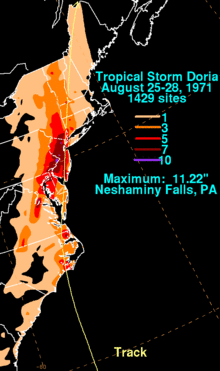
The perfect weather didn’t last long, though. By noon, it was clouding over, and by late afternoon the rains came. We didn’t know it at the time, but we were caught in the tail end of Tropical Storm Doria, churning its way up the Atlantic seaboard. We got some dinner somewhere, probably from one of the food vendors there, but found that the evening’s entertainment had been cancelled because of the rain. So we went back to the tent.

And it rained, and rained, and rained. The strong wind blew the rain up the slanted side of the tent and into the gap formed by the two shelter halves, so that we were getting constant drips from the peak. And before long, the water was going over the campground in rivers. I dug a shallow trench around the tent, but it was easily defeated by the rushing water. So we huddled in the tent, in our soaked sleeping bags, trying to get even a little sleep. The water-softened ground could no longer keep the tent stakes secured in the constant wind, so I would have to get up every hour or so and re-stake the tent. There would be no rest for me that night.

By morning, I got out of the tent to find that ours, as leaky as it was, turned out to be one of the very few tents that hadn’t been knocked down by the storm. The campground looked like a disaster area. The rain had stopped, but it had turned the festival grounds into a sea of mud, and we didn’t wait around for the inevitable announcement that the festival would be cancelled for the weekend. We piled all our wet clothes and sleeping gear into her MG and headed for home, stopping first for breakfast somewhere on the road, and then at a coin-op laundry where we commandeered the biggest dryers we could find. A few hours later, the sleeping bags and most of our clothing were dry again, and we were back on the road. We probably had dinner when we got back to Baltimore, and she dropped me off at my apartment at sunset.

When I opened the door, the phone was ringing. It was my friend Bill Gross, whose father owned an appliance store in Brunswick, Maryland. Brunswick is located on the banks of the Potomac River, which can be prone to flooding. This year, with the rainwater left by Doria, the river was rising to historic levels, and it looked almost certain that it would flood at least part of the town. The appliance store was a two-story structure, with almost all of the refrigerators and washing machines and televisions on the first floor; the second floor was largely vacant.

Bill was trying to recruit as many friends as he could to help him and his father move what was on the first floor up to the second floor. Could I help? I told him I would, and gave up any hope of having that nice warm shower I was looking forward to. Bill was in front of my apartment house a half an hour later, in a post-war Chevrolet pickup truck he was restoring. The front seat was already filled, so I hopped into the cargo bed, thankful that the rain had stopped by then. We drove directly to Brunswick.

By the time we had arrived, the river had already overflown its banks and reached the edge of town. Bill’s father, known to the townspeople as “Judge Gross” or, simply, the Judge (since he was also the local magistrate), was waiting for us, and I think that Bill’s brother John Lynch was there, too. We were shown a hand-operated freight elevator, with which we would move all the stock from the first to the second floor, along with all the records of the business. The operation was painfully slow—we could only load one or two appliances at a time, and then it would be a question of somebody raising the car by means of a rope and a system of many, many pulleys. With luck, we could move one load of appliances every twenty minutes. So most of our time was spent in drinking coffee and waiting for the elevator car to return to the first floor for another load.

The store was right next to the tracks of the Baltimore and Ohio Railroad, which had a major yard in the town at the time. So a train would rumble through every once in a while, shaking the building. The house that Bill grew up in was right next door, and I realized how it came about that he could sleep through just about anything. (Earlier that year, he told me to wake him by phone so that he could drive us into Washington to get tickets for a Vladimir Horowitz concert, and he swore that he would put the phone under his pillow. I let the phone ring for over ten minutes without effect. Now I understood why.)

And I remember that, on the first floor, the Judge had set up a service area for the televisions and radios he sold, with storage racks for more electronic tubes than I’d ever seen in one place before (except, possibly, in the electronics wholesaler’s shop where I worked two years earlier). We debated whether to add the tubes to the load in the elevator car, or just carry them up the stairs, but either Bill or the Judge had decided that they weren’t going to be damaged by the floodwaters, so it wouldn’t be worth the effort to move them. 

And that was how I spent that night: wrestling appliances and televisions into the elevator, taking my turn at hauling the rope to lift the car, and keeping the coffee pot filled. From time to time, we’d go out and check on the progress of the river, which was slowly inching toward the store. By sunrise, the entire contents of the first floor (except for the tubes) had been moved to the second floor, including all the test equipment in the service area. We had done all we could, so Bill drove us back to Baltimore. On the way home, I was able to ride in the front seat, where I could look out the window and, in the light of the dawn, see acres and acres of flooded fields. It could have been mistaken for a huge lake, had it not been for the occasional church steeple or a house or barn cupola poking up from the surface of the water. It was then that I realized the extent of the destruction of the storm.

I phoned Paul Morris, my boss at the Baltimore City Health Department, and told him that I’d be late that morning, as I needed to shower and eat breakfast. When I told him about what I’d been doing for the past forty-eight hours, he said, “Forget about coming in. We’ll cover for you. Just get some rest, and we’ll see you tomorrow.” By that time, what was left of the caffeine in my body was starting to wear off, and his words were music to my ears. I took that nice warm shower I promised myself the previous day and then hit the sack.

As it turned out, that night’s work proved to be unnecessary. The river rose to the level of the top of the store’s front steps, Bill told me later, but the first floor itself stayed dry. After a week or two, all the stock had been returned to its proper place and the store was back in business. His dad was one of the lucky ones, though. Dorian proved to be the one of the costliest storms of that year’s hurricane season, breaking countless records for rainfall and causing seven deaths and an estimated $147.6 million in damages throughout the east coast, from North Carolina to Vermont. 

And it only cost me a couple of night’s sleep, and I had a story to tell now. So I was one of the lucky ones, too.


Sunday, November 10, 2019

UP FRONT and Bill Mauldin


©2019 by John LaTorre

(This is an expanded version of something I posted on Facebook. I thought it deserved a more detailed review, so here it is.)

It's Veteran's Day today. I suggest you spend it doing what I often do: re-reading Bill Mauldin's remarkable Up Front.

I see the book from time to time in used bookstores, where it's usually filed under "Humor" because it consists mainly of the cartoons of soldiers that Mauldin drew for the Army's Stars and Stripes newspaper when he served in World War II. If you want to buy a new copy, you'll find that it's still in print after over seventy years, and still regarded as one of the definitive books of World War II.

Mauldin wasn't the first to chronicle a war in cartoons. There was a British artist named Bruce Bairnsfather whose work appeared during World War I and whose stock character of "Old Bill" would be the spiritual father of Mauldin's "Willie and Joe." Bairnsfather was a soldier himself, wounded by poison gas, shellfire, and post-traumatic stress disorder. Removed from the front lines, he convalesced in a London Hospital, where he began drawing war-related cartoons. The war was still going on after his discharge from the hospital, so he was reassigned to a training unit, where he came up with the "Old Bill" character that would make him famous. Unlike many of the cartoonists of the day, Bairnsfather strove for a realism that helped convey what the British soldier was actually seeing and experiencing, a technique that Mauldin admired and would soon make his own. Bairnsfather would eventually return to drawing cartoons for the Stars and Stripes and Yank magazine as an "official cartoonist" for the US Army during World War II, after which he sank into obscurity and died penniless in 1959.

While Bairnsfather was drawing for the Stars and Stripes, Mauldin was already making his own reputation, first with the 45th Infantry Division News and then the Stars and Stripes; by the end of the war, he would be drawing six cartoons a week for the latter newspaper. He accompanied the army's invasions and was eventually given a jeep and a free hand in visiting the front lines, as long as he kept drawing cartoons that reflected the common soldier's point of view. Like Bairnsfather, he would be wounded in action (by mortar fire) and be hospitalized, an occurrence that had the benefit of increasing his credibility with those soldiers. He ended the war with a Purple Heart, the Legion of Merit award and a Pulitzer Prize for his work.

But what sets the cartoons in Up Front apart from Bairnsfather's work is the commentary that accompanies the pictures. Mauldin's cartoons were often reprinted in newspapers back in the States, and the commentary was an attempt to let "the folks back home" know something about what inspired the cartoons, so they could make some sense of them. He did that, but he did something else, too: he wrote one of the classic books to come out of the Second World War.


"Me future is settled, Willie. I'm gonna be a perfessor on types o' European soil."

Mauldin tells about how ordinary farm boys and factory workers and clerks are transformed into combat soldiers, and how their lives change irrevocably. The soldier is no longer the boy who left home. He now lives with homesickness, rain, mud, sleeplessness, and "combat fatigue" (which is what they called PTSD back then). His sense of humor is now twisted, and his values are changed. Paradise for him now means dry socks, a hot meal, a warm bath, a stiff drink, and nobody shooting at him. He wonders if he has been forgotten by the folks back home. He gets wounded and spends a few days at a field hospital, but instead of going on leave, he goes back to his unit because he knows they need him there and he doesn't want to let his comrades down. He can feel pity and hatred and compassion all at once for the people he's fighting and for the civilian victims caught in the aftermath of the battles.

Mauldin relates all this flatly, without elaboration. You sense at once that he knows what he's talking about, because he's only telling you what he's seen and experienced it first-hand. He has a reporter's insight into what makes a good human interest story, and a storyteller's gift for telling it. He talks about good officers and bad officers, and the things that the Army is doing well or poorly.


In other hands, it might have come off as scathing indictments of the military, but Mauldin seldom editorializes. If you had asked him to do that, he would probably have responded with "Aw, shucks. I can't do that. I'm just a New Mexico farm boy who just happens to be able to draw a little bit." And he'd give you that broad farm-boy grin, and you'd walk away wondering how that rube could possibly be the same one who created such trenchant cartoons. Even with such a disarming persona, he would occasionally ruffle a feather or two, but he had a friend or two in high places that would take the heat for him. (One of his champions was General Eisenhower himself.)


After the war, he would continue to draw trenchant cartoons, eventually winding up as the editorial cartoonist for the St. Louis Post-Dispatch, where he won a second Pulitzer Prize for his work. From there, he went on to the Chicago Sun-Times, which employed him for the rest of his career. When he retired in 1991, he was acknowledged as one of the great editorial cartoonists of the century.

He wrote a few more books, but his legacy will always be his first book, Up Front. It is, for my money, the best non-fiction book ever written on the American soldier in combat. Your library probably has a copy. Check it out and read it.

Sunday, August 18, 2019

The Science of Flight


©2019 by John LaTorre

In 1957, the Russians sent a satellite into orbit, a feat that was beyond the capabilities of the United States at the time. This event sent shock waves through the American educational system. It may also, in some small way, have set the course of much of my life.

You see, one of the things that came out of this shock wave was a re-evaluation of the way science was taught in schools. The government declared that if we wanted to catch up to the Russians in the "Space Race," there had to be a greater emphasis in training students for a future in aerospace, at as early a level as they could absorb. It was with this grand intention that the government sent out educators to spark interest in aerodynamics.

My fourth-grade class was one of the beneficiaries of this new emphasis on aviation science. This would have been in the spring of 1958, before the National Aeronautics and Space Administration had been set up, but already the government was taking steps to put the educational program into effect. Some students in my class, myself included, received some special training in the form of two energetic men who evangelized the glories of aviation. The name of the program was "The Science of Flight" and was introduced, I am sure, not only in my elementary school but in hundreds, maybe thousands, of other elementary schools around the country.

Up to that point, my experience in the subject amounted to a few rides in the DC-3 passenger planes that Allegheny Airlines flew between Syracuse and Washington, D.C., a cross-ocean flight in something like a Pan Am  DC-6B, and the construction of numerous plastic models of rockets and space ships being offered at the time by Revell, Monogram, and Aurora. How that experience amounted to a résumé that qualified me for the class is more than I can explain, but there I was, watching the energetic men displaying models just like the ones I was building, along with model airplanes and cross-sections of airplane wings.

The two men handed out paper fresh from the mimeograph machine, still fragrant from the alcoholic ink. Crude purple line diagrams, looking as though they'd been sketched out only moments before the class began, indicated the form of an airplane's wings, with all the forces acting upon it: the upward arrow of lift, the downward arrow of gravity, the forward arrow of thrust, the backward arrow of drag. And I recall other fragrant pages with pictures of rockets on them, showing how all the stuff pouring out of the rear ends of these rockets created forward propulsion, even in the vacuum of space. But that's all I really remember about the class, apart from the fact that my ten-year-old mind kept drifting to the spring weather outside and how it could be put to better uses than sitting in a classroom.

But seeds were sown then. Years later, as I forsook a civil service career for a job as an instructor in the nascent hang gliding industry, I found myself teaching those principles of aerodynamics to my first-day students. Those old pictures came back to mind in the form of explanations of why hang gliders worked. There was no vector of thrust, of course, but there were my old friends drag and gravity and lift, still up to their old tricks. Gliding flight was simply a matter of transmuting the forces of gravity and lift into forward motion, all the while attempting to reduce drag to a minimum. It was all very clear to me.

Of course, it took many and many a flight on small hills and dunes before I could grant a hang glider the trust to bear my weight, so that I could launch one without a moment's doubt that it would obey those immutable laws of physics. And it would take longer to realize that, on a high, windswept cliff, I would be more comfortable strapped into a glider than merely standing on the precipice. But I submit that I would never have even taken up the sport if I hadn't been convinced that those laws of physics could be depended on.

Even later, when I started test flying prototypes and production models, that confidence never wavered, although I realized that this particular glider, on this particular day, might get it into its head to kill me if I allowed it to. It's not that the glider ignored the laws of aerodynamics, but that through a designer's misunderstanding of those laws or a flaw in the manufacturing process, it would apply its form to an unexpected interpretation of those laws, and it would be up to me to sense it and do what I needed to do to make those laws work for me and not for it.

As glider design progressed, designers would be looking for ways to increase lift and decrease drag with every trick they could think of, taking airfoil design and streamlining to lengths I could scarcely imagine when I took up the sport. These gliders conformed to exactly the same laws that the earliest, crudest ones did, but it was a deeper appreciation and a cleverer application of those laws that allowed us to use them to our advantage.

I haven't the slightest idea whether "The Science of Flight" inspired the number of would-be aeronautical engineers that it intended to, and whether it actually made a difference in the "Space Race" or beyond. But I have to give it credit for introducing the basics of aviation to me, so that flight would be not a mystery but a part of a rational, scientific world, where lift, like gravity, could taken on faith. It was with that same confidence in the laws, and the same trust in technology, that humans would fly higher and faster, and eventually land on the moon's surface itself. What seemed a miraculous leap in technology was really no miracle at all. Perhaps the real miracle happened long ago, when someone realized that our world operated on rational, scientific principles, and that once we figured those out, we could harness our imagination to the natural world, and see how far it would take us.

Friday, August 2, 2019

A Rock in the Shape of a Peanut


©2019 by John LaTorre

Somewhere, out beyond the orbit of Pluto
There's a rock in the shape of a peanut.

How do we know this? Well, we sent a robot to Pluto, some years back.

It took pictures of the dwarf planet
Which used to be called a planet once.
(But Pluto is a dwarf planet now,
one of many dwarf planets in a huge debris field at the edge of our solar system,
a debris field we call the Kuiper Belt.)

But the robot still had a bit of fuel left,
so we sent it in search of a rock in the Kuiper Belt
That we'd just spotted with powerful telescopes here on earth.

What was this rock?
What was its size and its shape and its path through the cosmos?
We had to know.

So we spent thousands and thousands of dollars on expeditions to faraway places here on earth,
and set up telescopes to measure what we could of its trajectory and orbit.

And we measured its size from the star it blotted out in its transit.

But we still didn't know its shape.

And that was important to know,
because it could maybe tell use how the solar system came to be,
or so the astronomers tell us.

So we sent the little robot to take a closer look,
since it was heading that way anyway,
on its journey to oblivion.

And we found that the rock was shaped like a peanut
... a very big peanut, to be sure, some twenty miles long
but shaped like a peanut just the same.

Maybe it was a foolish thing to learn,
since the expeditions on Earth cost thousands of dollars to mount,
while children there were starving to death.

On the other hand,
the thousands of dollars weren't spent on weapons of war,
so maybe lives were saved. Who's to judge?

Such a curious species we are,
to care so much about a rock that we cannot see with the naked eye,
in a place we will probably never visit in a hundred lifetimes.

But now we know that it is about twenty miles long and shaped like a peanut.

And we have done several miraculous things in a row,
to send such a tiny robot on such a long trip,
to photograph the rock and send the pictures back at the speed of light,
which still took six hours to reach us from its location.

We have named this peanut-shaped rock "Ultima Thule"
which means "the farthest point."

But we know that this is a lie.

There are other points farther still,
and if our little robot does not reach them, other robots will.
Maybe these rocks will be shaped like carrots, or potatoes,
or perfectly round marbles like the rock we live on.
We don't know yet.

But we do know of a rock that is shaped like a peanut,
a rock we didn't know about at all until just a few decades ago.

And we know it because we simply had to know it,
because nothing would do but that we find out as much about it as we could.

These words define our species:
"What we can know, we must know.
What we can do, we must do."

If it should come to pass, in some unknowable future,
that some other life form might find those little robots
and trace their paths back to our rock that is shaped like a marble
And wonder whatever became of the life that spawned the little robots,

"What we can know, we must know.
What we can do, we must do."

will be as good an explanation as any

and would do nicely as an epitaph.

Saturday, March 2, 2019

Blackface, Jocko, and Fantasia’s Centaurs


©2019 by John LaTorre

 In the early 1970s, I was working at a print shop in Baltimore, Maryland when an elderly gentleman came in asked us to print some copies of a children’s book he was publishing.  The book’s title was Jocko: A Legend of the American Revolution, and told a story that I had never heard before.

 Briefly, the story was about the origin of “Jocko,” the statue of a lawn jockey that was a common sight in the area in the last century. Rather than exemplifying a racist past, the book asserted, the statue memorialized a heroic volunteer who died during the Revolutionary War. He is said to have frozen to death while tending George Washington’s horses, and the good general decreed that a statue of the boy be erected at Mount Vernon, after which (as the story goes) it was copied by people who wanted to emulate our first President.

The man’s name, I learned, was Earl Kroger, Sr. I don’t know where he got the story and, apparently, neither did anybody else. He might have made it up of whole cloth, in an attempt to “repurpose” a racist image into one that African-American children could take pride in. While there have been efforts to trace the story’s origins, no evidence of its existence has surfaced from the records of Mount Vernon or in contemporary accounts. But that hasn’t stopped the story from spreading.

I was reminded of the book after the controversy erupted about a picture of Virginia Governor Ralph Northam taken during his college days. It showed two people, one in a hooded robe like the one used by the Ku Klux Klan and the other in a classic stereotyped blackface entertainer costume. The latter was presumed to be Northam, and there were calls for him to resign in the interests of cultural sensitivity.

It’s hard for people today to imagine just how prevalent these racist stereotypes were in that part of the country at that point in time, and how little attention they received. I’d lived in Maryland from 1952 to 1957, in Virginia from 1962 to 1964, and again in Maryland from 1966 to 1978, and I saw a lot of those lawn statues. In those days, “Negroes” were often depicted in drawings as black-skinned creatures with thick red lips, huge teeth, and googly eyes  -- not only in print, but in much of the animated art of the first half of the twentieth century. These cartoons were short subjects preceding the feature films of the day, and were later recycled as staples of the cartoons seen on Saturday morning television in the 1950s, when I first saw them. These caricatures even appeared in Walt Disney’s classic Fantasia, originally released in 1940. The sequence accompanying Beethoven’s “Pastoral Symphony” portrayed black centaurs as nappy-haired “pickaninny” stereotypes shining the hooves of the white centaurs. (If you don’t remember this scene in the movie, you probably saw the reissued version of 1990, which panned away from the black male centaurs to the white female centaurs, or the 1969 version which deleted the scene altogether, causing a jarring gap in the musical score.)


This was the world that I grew up in, and that Governor Northam grew up in. We were so steeped in the culture of the vestiges of white supremacy that we seldom gave it much thought. There are no non-white faces in the picture above, of my second-grade class in Bethesda, Maryland. And the high school I went to in northern Virginia had less than a dozen non-white students out of maybe fifteen hundred students altogether, and none on the faculty itself. If I’d been asked to perform in blackface for a school skit, I might have done it, not because I wished to denigrate blacks but simply because I had been taught that this was OK in comedy, that it was expected, and that there would never be repercussions. And back then, it might have been true.

We’ve come a long way since then. Blackface is no longer considered cool, “Jocko” lawn statues are less common now, and those old cartoons are seldom seen anymore. Granted, we still have a long way to go. But by excoriating Governor Northam for what he did over thirty years ago, we are painting a false view of history, pretending that we were always as tolerant and open-minded as we are now. But history can’t be so easily edited. Hattie McDaniel’s Oscar-winning role as “Mammy” will continue to be an integral part of Gone With the Wind, and Bill “Bojangles” Robinson’s dance steps will hold up even when his caricatured costume doesn’t. If we edit out the stereotypes of the era, we also lose those remarkable performances. Nor will it do for us to re-write history, as Earl Kroger seems to have done, to make what was once disgraceful now seem heroic. That leads us down the road of dishonesty already marked by school textbooks that call slaves “indentured servants” and the Trail of Tears as a “voluntary migration” of Native Americans.

It would serve us better to admit that, yes, we were once blind to the issues of race and gender, and that we were doing the best we could with the culture we had ourselves inherited. Since then, we have learned what was hateful and insensitive, and taken steps to reduce the influence of those things and to no longer let them be a part of our culture. We also admit that sometimes we don’t do a very good job of it, and that there will be things in our past that we now look upon with repugnance … things that we wish undone. To be a product of our times is not something we look upon with pride, but neither should we be ashamed of it unless we continue to perpetuate the evils of those times. I would even submit that our repudiation of slavery and genocide and sex discrimination is a sign of hope, because it marks a profound shift in our culture. If there is opprobrium to be leveled at Governor Northam and his friend, it should not be at what they did back then, but at whether or not they regret it now.

I’ve written before about the need for a process of “reconciliation” for addressing the rising awareness of sexual intimidation and denigration. (The essay, if you’re interested, can be found at http://jayeltee.blogspot.com/2017/12/blessed-are-merciful.html ) South Africa used this approach to help repair the societal rifts caused by apartheid. The process of reconciliation acknowledged that there were whites who had committed crimes against native Africans, but provided a path to forgive their sins and allow to continue with their lives without further retribution. It was not a process of exoneration, but of acceptance; these things happened, and they shouldn’t have happened, but there is no way of undoing those things. Instead, we consign them to our past, and resolve that we can live together in a future society where these things won’t happen again. While the reconciliation process has hit a few bumps and hasn’t pleased everybody, most South Africans seem to think that it was worth doing.

I see no reason why we can’t extend the same forgiveness to Governor Northam and all the rest who have sinned against their humanity. If they have truly renounced the mind-set that prompted them to do these things, shouldn’t they be allowed to continue to do the good things they are doing now?

We have never expected our political leaders to be saints, but we can and should expect them to be imperfect humans who strive to reduce their imperfections and resolve to “sin no more” as Jesus is said to have commanded.  And let us also remember what Jesus said just before that: “Let he who has not sinned cast the first stone.” Not many of us would qualify for that prerogative, and that’s a good thing; people who have never sinned probably wouldn’t be much fun to be around. Give me imperfect people any day, as long as they hold perfection as a goal always to be aimed for, if not always to be met.